Visas

All visitors to the Republic of Korea must have a valid passport and visa.

Visitors with roundtrip tickets from countries who have a special agreement with Korea may be exempt from the visa requirement, and can stay in Korea visa-free for up to 30 days or 90 days, depending on the terms of the agreement between two countries.

If uncertain about the entry requirements into the country, please contact your nearest Korean embassy or a consulate as soon as possible.

For more information:

http://www.mofat.go.kr/ENG/visa/application/index.jsp?menu=m_40_10


Airports

Overview
Fly to South Korea

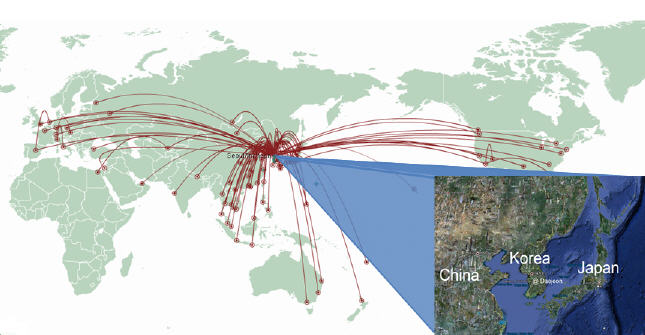
Where is Daejeon: In the center of the Korean peninsula

Airports

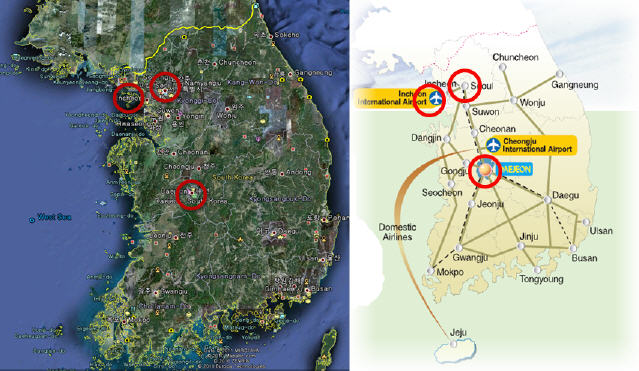
We have three international airports near Daejeon: Incheon International Airport (ICN), Gimpo International Airport and Cheongju International Airport (CJJ) .

Incheon International Airport (ICN)
Incheon International Airport (ICN), located 220km northwest of Daejeon, is a main gateway to South Korea. It represents a premier regional gateway, and provides flights to all major hub-places over the world. If you plan to fly directly from abroad, you are recommended to choose ICN:

For further information see below:

Incheon International Airport (ICN) guide (10.33 MB):

Incheon International Airport (ICN) website: http://www.airport.kr/eng/:

Gimpo International Airport (GMP)
Gimpo International Airport (GMP), located 180km northwest of Daejeon, is an international airport in Seoul, previously served as a main gateway to South Korea before the opening of ICN in 2001. Passengers from Nagoya, Tokyo/Narita, Tokyo/Haneda, Shanghai(Hongqiao), Manila, Minneapolis, Munich, Bangkok, Beijing, Guangzhou, Vladivostok, Osaka(Kansai), Yantai, Pudong, Saipan, Sapporo, Shenyang, Qingdao, Taipei, Hanoi, Hangzhou, Hochiminh, Hong Kong, Fukuoka, Weihei, Sanya, Siem Reap, Changsha may use this airport:

For further information:

Gimpo International Airport (GMP) website: http://www.airport.co.kr/doc/gimpo_eng/:

Cheongju International Airport (CJJ)
Cheongju International Airport (CJJ) is the nearest airport to Daejeon, located 37km north of Daejeon. But it provides limited flights to places including Jeju island, and Shanghai, Shenyang and Hong Kong.

If you plan to fly directly from abroad, you are NOT recommended to choose this airport.
But if you fly from Jeju International Airport, where ACL 2012 is held, we recommend that you fly to Cheongju International Airport (CJJ) (say, NOT to Incheon International Airport (ICN)).

For further information see below:

ARS: +82-43-210-6114
Tel.: +82-43-210-6312~6316
Tel. (weekends and nights): +82-43-210-6309
Cheongju International Airport (CJJ) website: http://cheongju.airport.co.kr/doc/cheongju_eng/


From Airports to Hotels

From ICN (Incheon International Airports) to Hotels

Access from Incheon International Airports (ICN)
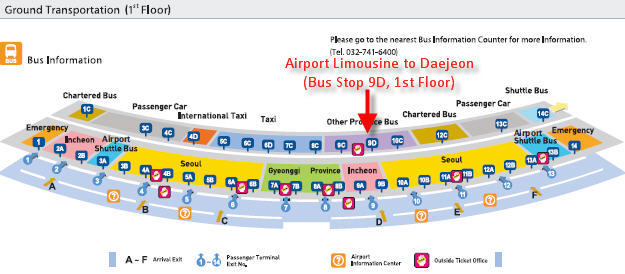
  • Option 1: Take an airport limousine bus to Daejeon Dongbu (Daejeon East)
    and then take a taxi to your hotel
    • Where to take an airport limousine bus: Bus stop 9D
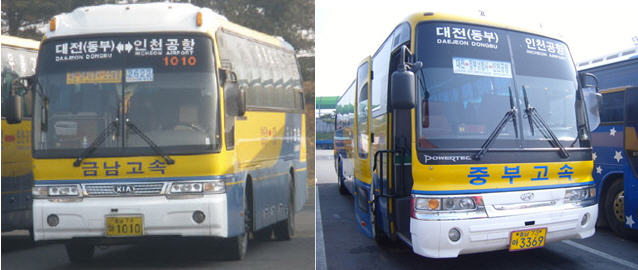
    • It looks like this:
      (You might be interested in the color combination of the bus and Korean on the windshield.)
    • Limousine bus fare: 22,100 KRW/person
    • How much time does it take: ca. 3 hrs
    • How frequent: Every 20 - 40 minutes (see the timetable blow)
      06:00, 06:20, 06:40,
      07:00, 07:20, 07:30, 07:50,
      08:10, 08:25, 08:50,
      09:10, 09:30, 09:50,
      10:20, 10:40,
      11:00, 11:20, 11:50,
      12:20, 12:40,
      13:00, 13:40,
      14:10, 14:40,
      15:10, 15:40,
      16:10, 16:30, 16:50,
      17:10, 17:30, 17:50,
      18:10, 18:40,
      19:00, 19:20, 19:40,
      20:00, 20:20, 20:50,
      21:20, 21:50,
      22:10(midnight express), 22:40(midnight express),
      23:10(midnight express)
    • Take a taxi from Dongbu bus terminal to your hotel: fare ca. 10,000 KRW to the hotel area in Yuseong

From GMP (Gimpo International Airports) to Hotels

Access from Gimpo International Airport (GMP)
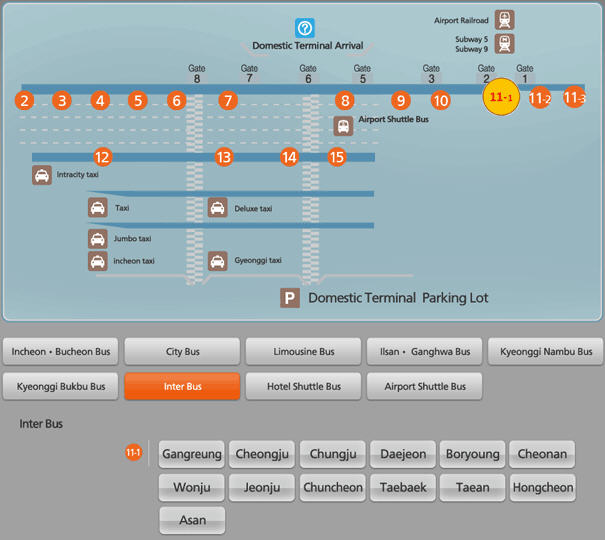
  • Option 1: Take an airport limousine bus to Daejeon Dongbu (Daejeon East)
    and then take a taxi to your hotel
    • Where to take an airport limousine bus: Bus stop 11-1 (Gate 2)
    • It looks like this:
      (You might be interested in the color combination of the bus and Korean on the windshield.)
    • Limousine bus fare: 13,500 KRW/person
    • How much time does it take: ca. 2 hrs 40 min.
    • How frequent: Every ca. 1 hour (see the timetable blow)
      07:30
      09:00
      11:00
      12:00
      12:50
      14:00
      15:00
      16:10
      17:00
      18:00
      18:50
      19:40
      20:30
    • Take a taxi from Dongbu bus terminal to your hotel: fare ca. 10,000 KRW to the hotel area in Yuseong

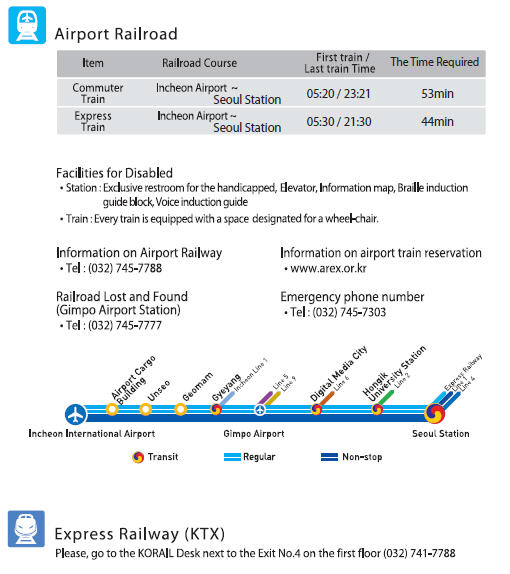
  • Option 2: Take an Express or a Commuter Train (16 - 20 min.) to Seoul Station
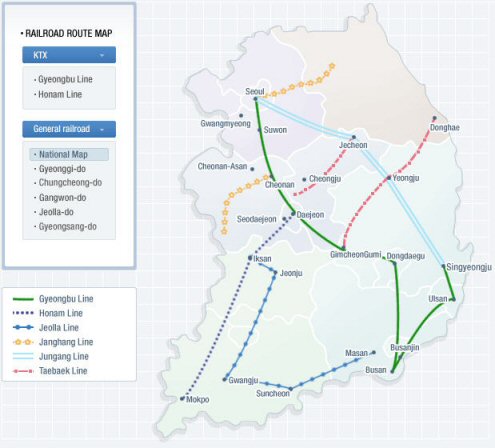
    and then a KTX express train (ca. 1 hr) to Daejeon Station
    and then take a taxi to your hotel
    • Take an Express (16 min.) or a Commuter (20 min.) Train to Seoul Station
      Information about the Airport Railrod to Seoul Station
      See also Incheon International Airport (ICN) guide (10.33 MB)
    • Take a KTX express train (departs every 20-30 min, takes ca. 1 hr) to Daejeon Station
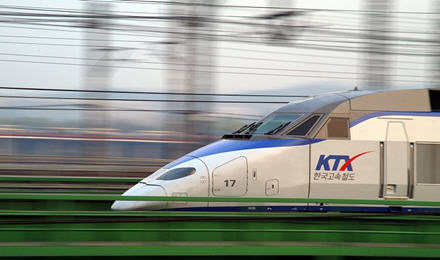
    • The KTX train looks like this:
      (You might be interested in the color combination of KTX and Korean on it.)
    • Take a taxi from Daejeon Station to your hotel: fare ca. 8,000 KRW to the hotel area in Yuseong

    From CJJ (Cheongju International Airports) to Hotels

    Access from Cheongju International Airport (CJJ)
    • Option 1: Take an airport limousine bus to Daejeon Dongbu (Daejeon East)
      and then take a taxi to your hotel
      • Where to take an airport limousine bus: The bus station at the entrance of the airport (1st floor).
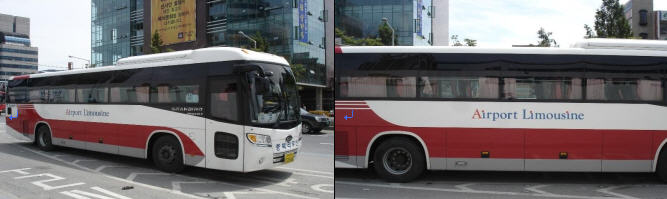
      • The bus looks like this:
        (You might be interested in the color combination of the bus and Korean on the windshield.)
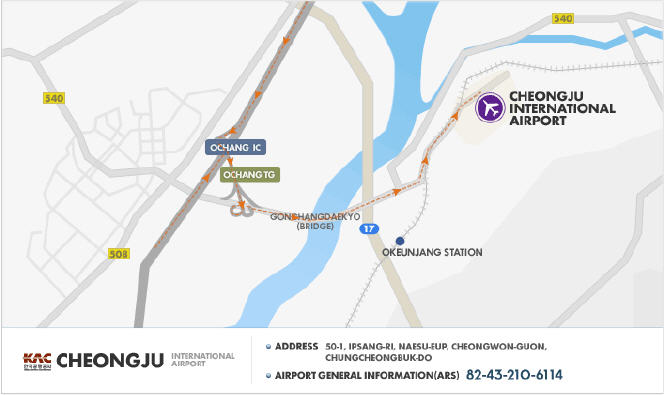
      • Limousine bus fare: 3,500 KRW/person or 3,700 KRW/person (via Ochang plaza)
      • How much time does it take: ca. 50 min.
      • How frequent: See the timetable blow
        11:20
        14:40
        17:50
        18:50
        21:55
      • Take a taxi from Dongbu bus terminal to your hotel: fare ca. 10,000 KRW to the hotel area in Yuseong

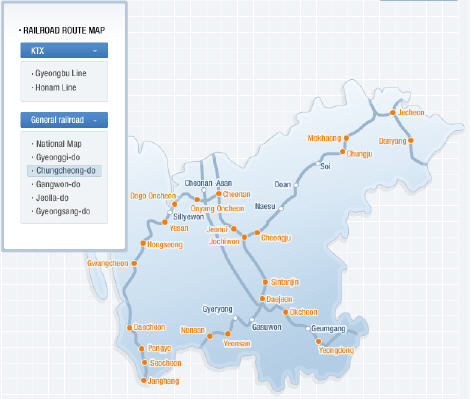
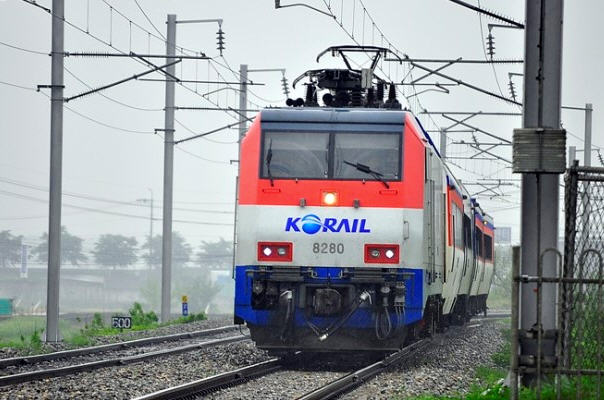
    • Option 2: Take a Mugungwah Train (ca. 50 min.) to Daejeon Station
      and then take a taxi to your hotel
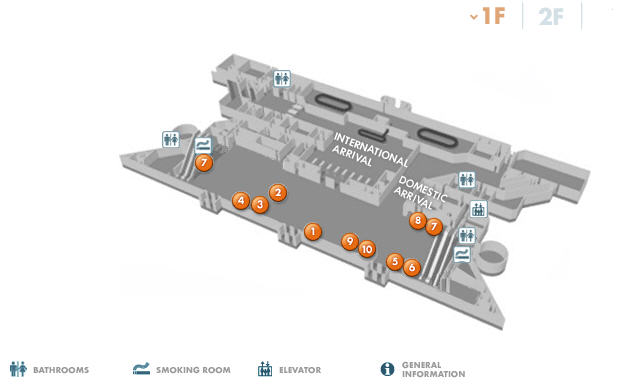
      • Where to purchase a ticket: Chungbuk tourism information desk on the 1st floor (the point marked with ① on the map below)
      • Where to take a train:

        ※ For the convenience of passengers, shuttle bus is on operation between Airport Station ⇔ Airport passenger terminals.
        Inquiry phone number (043) 210-6328
      • Take a Mugungwha train (fare: 3,900 KRW/person)
      • The Mugungwha train looks like this:
        (You might be interested in the color combination of the Mugungwha train.)
      • How frequent: See the timetable blow
        07:11
        09:02
        10:14
        11:54
        13:57
        16:29
        18:24
        20:20
        22:06
      • Take a taxi from Daejeon Station to your hotel: fare ca. 8,000 KRW to the hotel area in Yuseong

      For further information visit the CJJ homepage:

      Cheongju International Airport (CJJ) website: http://www.airport.co.kr/doc/cheongju_eng/:


Hangul/The Korean Alphabet

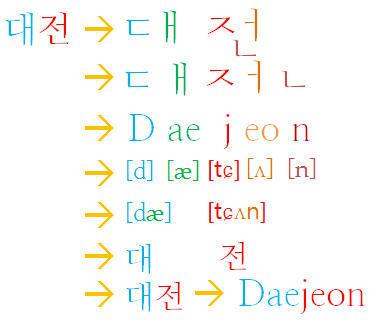
Mastering Hangul (한글, [ha:n.gɨl], also known as Hangeul, the Korean alphabet) in One Morning

Hangul in Wikipedia (a courtesy of wikipedia at http://en.wikipedia.org/wiki/Hangul)


(a courtesy of wikipedia at
http://en.wikipedia.org/wiki/File:Hangeul.svg)
Hangul, the Korean alphabet, is the native alphabet of the Korean language. It is a separate script from Hanja, the logographic Chinese characters which are also sometimes used to write Korean. It was created in the mid-15th century, and is now the official script of both North Korea and South Korea and is co-official in the Yanbian Korean Autonomous Prefecture of Jilin Province, People's Republic of China.

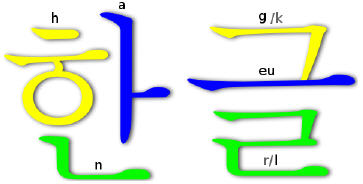
Hangul is a true alphabet of 24 consonant and vowel letters. However, instead of being written sequentially like the letters of the Latin alphabet, Hangul letters are grouped into blocks, such as 한 han; each of these blocks transcribes a syllable. That is, although 한 may look like a single character, it is composed of three distinct letters: ㅎ h, ㅏ a, and ㄴ n. Each Hangul block consists of two to five letters, including at least one consonant and one vowel. These blocks are then arranged either horizontally from left to right or vertically from top to bottom.
The theoretical total number of different blocks is calculated as 11,172, though far fewer are actually in regular use and neither does it equal the number of possible syllables, which are far fewer than 11,172. For a phonological description, see Korean phonology.

Learning basic Hangul in 10 minutes (a courtesy of YOUTUBE and BUSY ATOM)


a courtesy of YOUTUBE and BUSY ATOM

Recommended Books for Mastering Hangul during the Flight

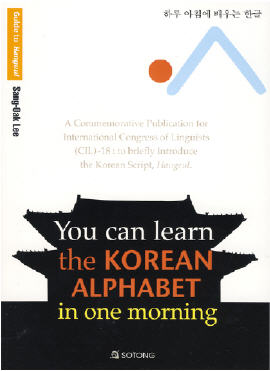
  • Author: Sang-Oak Lee (Prof. of Korean Linguistics, Seoul National University, emeritus)
  • Book title: You Can Learn the Korean Alphabet in One Marning [Paperback]
  • Price: $7.83 (9,000 KRW)
  • Publication Date: July 23, 2008
  • Paperback: 100 pages
  • Publisher: SOTONG
  • Language: English and (partly) Korean
  • Product Dimensions: 8.5x5.5x0.4 inches
  • Order at Seoul Selection

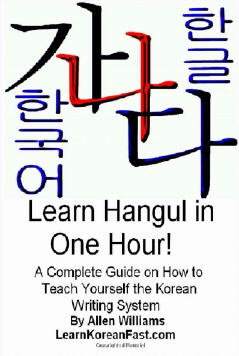
  • Author: Allen D. Williams (professional educator, writer, and speaker)
  • Book title: Learn Hangul in One Hour: A Complete Guide on How to Teach Yourself the Korean Writing System [Paperback]
  • Price: $5.99
  • Publication Date: March 18, 2012
  • Paperback: 76 pages
  • Publisher: CreateSpace
  • Language: English
  • Product Dimensions: 8.8 x 5.9 x 0.3 inches
  • Order at Amazon.com


Local Information

Climate

The climate of Korea is characterized by four distinct seasons: spring, summer, fall, and winter. During the conference it is expected to be really hot and humid. Be prepared for the hot weather, but the conference venue will be “cooling” off. The average temperature of Daejeon is about 24.0°C-25.0°C in July (cf average precipitation: 265~320㎜ in July ).

Currency & Exchange

The unit of currency in Korea is the Korean Won (KRW). Various notes and coins are used. Notes occur in 1,000, 5,000, 10,000 and 50,000 won denominations, while coins occur in 10, 50, 100, and 500 won denominations. As of June 2012, the exchange rate is approximately KRW 1,170 to USD 1 and KRW 1,460 to EUR 1. Foreign bank notes and traveler’s checks can be converted into the Korean won at foreign exchange banks and other authorized money exchange outlets. The exchange rate is subject to market fluctuations.

Time Zone

Standard Time in Korea is 9 hours ahead of Greenwich Mean Time (GMT+9).

Tipping

Although appreciated, tipping is not a customary practice in Korea.

Banking & ATM

There are plenty of places in Korea to change currencies, including banks, CVS, authorized currency exchanges and major hotels. ATM machines are ubiquitous, although not all offer services for foreign cards. Cards with the Plus and Cirrus logos are the easiest to use and most widely accepted in Korea. Banks are open from 9:00 a.m. to 4:00 p.m., Mondays to Fridays.

Business Hours

Government office hours are usually from 9:00 to 18:00 on weekdays and are closed on weekends. Most stores are open every day from 10:30 to 20:00, including Sundays.

Tax & VAT

Foreign tourists can receive nearly 10 percent VAT refunds for purchases at duty free shopping outlets. Goods must be taken out of Korea within three months of purchase to be eligible for a tax refund. A Value-Added Tax (VAT) is levied on most goods and services at a standard rate of 10% and is included in the retail price. At hotels, a 10% VAT is applied to rooms, meals and other services and is included in the bill.

Electricity

The standard electricity supply is 220-volts AC at 60Hz. Most hotels may provide outlet converters for 110 and 220 volts. It is advised that you check with the hotel beforehand.


BBB (Before Babel Brigade): Volunteer Interpretation Service
Whenever and wherever you encounter communication problems with Koreans, just call 1588-5644 and press a number for your preferred language. Your call will be quickly connected to a BBB volunteer's mobile phone through an automated switchboard, and you will soon receive interpretation service.

※ BBB volunteer services are available in 16 languages.

※ For more information, please refer to BBB Korea official webpage (www.bbbkorea.org). If you don’t have a mobile phone in Korea, just show a BBB card to any Korean nearby, so that he/she can Help you with their mobile phone.